
It is faith that keeps mankind alive and shapes its behavior and actions. However, a turmoil arises in the human psyche when any of these deep rooted beliefs, social or religious, are challenged by the power of science and reason. Based on this premise is the story of Shiladitya Bora’s Ab To Sab Bhagwan Bharose, which also provides an insight on how the spread of misinformation and false knowledge sows the seeds of discord and hatred in innocent minds.
Unfolding the narrative
Set in 1989 against the backdrop of an unnamed village in North India, Bhagwan Bharose opens with a Gandhian quote that sets the tone for what is to follow. The saying goes, “If we are to create peace in our world, we must begin with our children.”
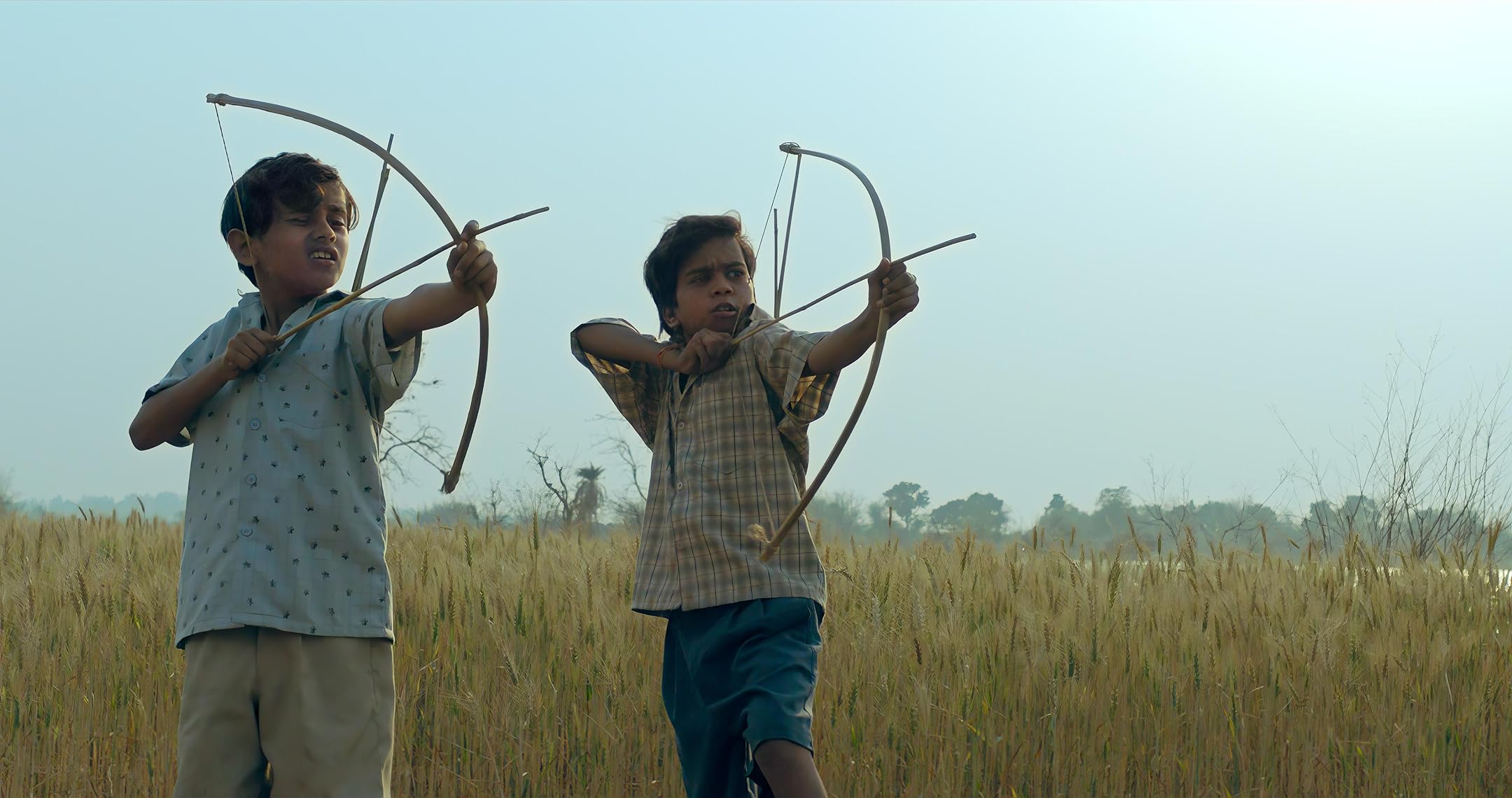
We are introduced to two little boys, Bhola and Shambhu, peeking at the village well and having a serious yet innocent chat about a mythological belief. Bhola’s life essentially revolves around his mother, grandfather Nanababu, and his constant companion Shambhu who never leaves his side. His father works in the city to support the family and visits intermittently.
In a village where progress happens at a snail’s pace, reason does not shed its light. Every incident that happens is attributed to divine intervention. Nanababu smilingly summarizes the situation: “Sheher mein har kaam sarkar bharose hota hai; gaon mein sab kaam bhagwan bharose hota hai!” (In the city, everything is up to the government; in the village everything is up to God!)
The local priest serves as a teacher and imparts lessons to kids in his courtyard, drawing everything from Hindu mythology. There is no scientific evidence to back his teachings, and Bhola and Shambhu accept his theories as though they are embedded in stone. Carefree and happy, the boys revel in their passion for flying kites and indulge in all childhood activities with unalloyed delight.
All goes well until Bhola’s father enrolls him in a traditional school. The knowledge imparted in the new classroom is totally contradictory to what the boys have learned from the pundit, and Bhola finds himself irked and in complete disbelief.
Nagging questions persist in his mind, and he gets confused and sad when his religious beliefs are at odds with scientific explanations. As the film progresses, many occurrences torment his mind, from otherwise mundane power outages to the unexpectedly wise words of a local atheist to a tragic loss in the family. Eventually, his exposure to another religion’s way of life and the sociopolitical tensions of the era lead to a series of tumultuous events that change his life forever.
The film’s official tagline asks a rhetorical question: in a world blinded by faith, can innocence win over hate? Bhagwan Bharose will indeed compel you to ponder upon this reality that engulfs humanity in present times.
The story comes alive with actors who shine with their prowess!
Child actors Satendra Soni and Sparsh Soman are the pivotal characters in the film, and they truly hit the mark. Satendra as Bhola carries the entire weight of the film on his shoulders, and he does an outstanding job, emoting flawlessly and delivering his dialogues with unencumbered ease. Sparsh as Shambhu has lesser scope but does his part by making his presence felt and appreciated. On the same note, Shiladitya Bora deserves due credit for bringing out such stellar performances from these fresh talents.
Veteran actor Vinay Pathak, as the endearing Nanababu, is great as always, and Masumeh Makhija, as Bhola’s mother Radha, rightfully stands out as an emblem of maternal warmth.
Shrikant Verma’s performance as the priest is convincing, wonderfully etched with streaks of buffoonery and fanaticism. Essaying the part of the much-reviled atheist in town, Manu Rishi Chaddha leaves a mark, doling out pearls of wisdom which leave an impression in the mind even when the end credits roll.
Enjoy a laugh or two!
The humor is refreshing and uplifting. It is subtle and flows naturally, in no way denigrating the seriousness of the subject matter.
To cite an example, the naiveté of the villagers is portrayed through a comic scene. When a monkey sits on a TV antenna and interferes with its transmission, one of the village locals is in complete awe that Lord Hanuman has come to bless them.
A neatly assembled package
Bhagwan Bharose is Shiladitya Bora’s debut feature film, and it has indeed gotten off to a glorious start with a win of the Best Film Award at the 25th UK Asian Film Festival. Bora’s directorial brilliance is exemplified by his choice of the perfect actors for the work and his success in putting together a talented team that delivers its best.
Graced by poignance and simplicity, the film is based on a story by Sudhakar Nilmani Eklavya, with screenplay and dialogues co-written by Mohit Chauhan. Seamlessly crafted, the narrative endorses a theme that has a universal appeal. The pace could have been better to get to the climax a little earlier, but despite this minor hiccup, the story manages to keep you engaged.
The background score by Indian Ocean is soothing, and the photography by Surjodeep Ghosh manages to artistically capture the natural beauty of a village.
Glitz and glamor are totally absent from Bhagwan Bharose. With utmost honesty, it portrays the sad realities that afflict today’s society. It is a parable of how blind faith can destroy the fabric of society.
There is no moralizing, but the message emerging from the story succeeds in enlightening the audience. The lesson that rises to the brim is that love, respect, compassion, and tolerance are the ideals that we need to foster in our children in order to build a world of peace and harmony.
(This review was published in India Currents)

 rashmi writes