

Image source: Wikimedia Commons
The Indian panorama presents an impressive gallery of cultures, traditions, and festivals that attest to the richness and grandeur of a millennia-old civilization. While observing these various celebrations, a fascinating discovery emerges. Within these unique customs, there exist some core commonalities that bind so many people together to identify as one whole India.
One major festival widely and enthusiastically observed across different states is Makar Sankranti. It is the occasion on which Indians, in their distinctive ways, immerse in the joys of the harvesting season.
A celebration of the winter solstice
Dedicated to Surya Devata, the Sun God, Makar Sankranti marks the northward movement of the sun. It is the day on which the sun, on its celestial path, transits from the zodiac of Sagittarius (dhanu) to Capricorn (makara).
Known as uttarayana, this journey of the sun is believed to bring in longer and warmer days. On the agricultural front, it is a favorable time. There is an abundance of fresh produce from the land, and thanks are offered to Mother Earth for a bountiful supply of food.
Makar Sankranti is one of the very few Hindu festivals based on the solar cycle. It is usually observed on January 14, but in a leap year, the date shifts to the 15th. Pomp and joy mark this day that is considered to usher in peace, prosperity, and happiness.
Why is Makar Sankranti considered auspicious?
Enthralling myths and legends build the framework of religion, and here are a few stories that explain the significance of Makar Sankranti.
Legend says that the festival is named after a deity Sankranti. To put an end to the ferocious killing of human beings by the demon Sankarasur, the goddess killed him on that day. She had slayed another demon named Kinkarasur on the day following Makar Sankranti.
A belief exists that those who die on the day of Makar Sankranti attain moksha or salvation. It has been associated with enlightenment, the ultimate goal of a meaningful life. We find one such reference in the Mahabharata. Bhishma was granted a boon by his father King Shantanu to choose his own death. So after being mortally wounded in the Kurukshetra War, he waited till Makar Sankranti because he wished that his final journey from earth follow the path of light.
There is another story that is rather intriguing. According to the Puranas, Lord Surya visits his son Shani on the day of Makar Sankranti. Although their relationship otherwise is not cordial, this is the day when they cast aside all differences and bond. The event of Makar Sankranti therefore holds the importance of a father-son relationship.
The tales behind a handful of sesame seeds
Makar Sankranti is sometimes known as Til Sankranti because of the extensive use of til or sesame during the festival. The health benefits of sesame seeds are extraordinary. Amongst other advantages, their consumption protects against arthritis, diabetes, and heart disease, and they are an excellent source of plant protein. However, on a religious level, there are stories from the Hindu scriptures that explain why sesame is considered sacred.
The sun god Surya is regarded as the source of all life and energy, and til is thought to be the source of solar energy. As a mark of respect to Surya and to seek his blessings, sesame is eaten.
It is believed that Lord Vishnu’s sweat turned into sesame seeds when in utmost anger he killed Hiranyakashipu for torturing his son. Another story narrates that the sweat of Vishnu trickled down as sesame during samudra manthan, the churning of the ocean by the demons and gods to produce the divine elixir of immortality.
Sesame is supposed to have been blessed by Lord Yama, the god of death. Therefore they are accepted as the seeds of immortality.
Having understood what Makar Sankranti is all about, let us see how different states in India observe their unique customs on this auspicious day.
Traveling through some Indian states
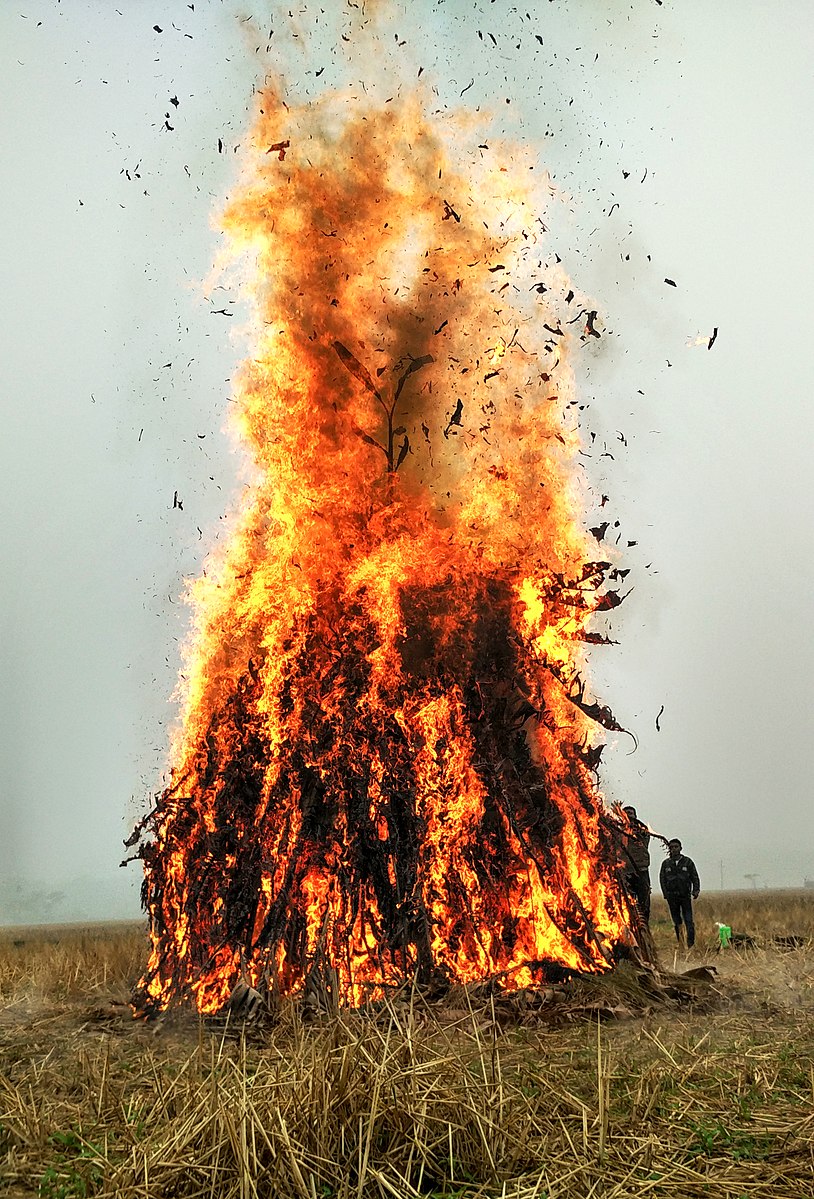
Image source: Wikimedia Commons
My personal sentiments of Makar Sankranti are obviously tied with Magh Bihu, the festival celebrated by the people of Assam. Also known as Bhogali Bihu (bhog meaning eating), it is a time of great feasting.
For several days, the kitchen would buzz with activity right from the morning in preparation for the event. We would hear rice being pounded and coconut being grated, and the roasting of sesame and melting of jaggery filled the nostrils.
The day before Sankranti is called uruka. People gather around bonfires at night, and joy is at its zenith. Scrumptious, majestic meals are prepared with duck, chicken, fish, and seasonal vegetables as part of an elaborate menu. The next morning, mejis or makeshift huts made out of twigs, bamboo, and hay, are burned. Prayers are offered to Lord Agni. The Bihu breakfast is a big spread of larus and pithas, two of many signature Assamese delicacies.
Poush Sankranti or Poush Parbon is observed with great enthusiasm in West Bengal. Also called pithe parbon, different types of delicious pithe are prepared from rice flour. Payesh made out of milk and date palm jaggery and pathisapta are among the many items prepared. The Ganga Sagar Mela is held every year around this time. People come from all over the nation to take a holy dip at the confluence of the river Ganges and the Bay of Bengal.

Image source: Unsplash
Uttarayan is the name of Makar Sankranti in Gujarat. After their morning bath and prayers, people fly kites, and it is an array of beautiful colors in the blue sky. The words “kai po che” rent the air. The flying of kites is thought to bring in good fortune. Delicacies that are relished include undhiyu (a dish prepared with mixed vegetables) and chikki (made of sesame seeds and peanuts).
Makar Sankranti in Uttar Pradesh is known by the name of Khichdi Parv. The special dish of khichdi is prepared and offered before the sun god to be eaten as prasad later. The sharing of laddoos made of jaggery and sesame is another highlight of the festival.
A day before Makar Sankranti, Lohri is celebrated in Punjab and primarily marks the harvest of rabi crops at the end of winter days. Prayers are offered to the sun and fire gods. Dressed in traditional attire, there are songs and dances around bonfires at night.

Image source: Wikimedia Commons
Based on the same premise of the harvest festival, South India celebrates Pongal. Pongal means “spilling over”. The name is traced to the tradition of making a dish when the newly harvested rice is boiled in milk with jaggery till it overflows. It is later offered to Lord Surya.
Usually a three or four day affair, Bhogi Pongal, Surya Pongal, and Matu Pongal are the three festival days with Kanum Pongal being the day to wind up the celebrations. The long list of rituals includes discarding old possessions, cleaning and decorating houses, paying respect to cattle, and participating in events to kindle community spirit.
Preserving traditions that define us
We love to take pride in our culture and heritage because the customs and traditions that we follow essentially define who we are. They become even dearer to us when we are thousands of miles away from our motherland. There is always an earnest desire to pass on the legacy to our next generation.
Makar Sankranti is about recognizing abundance and being grateful for the blessings bestowed upon us. To all those who celebrate, may warmth and goodness fill your days, and may happiness and peace grace your lives!
(This article was featured in India Currents )

 rashmi writes
