
It was a complete 180-degree turn from a conversation about some comedy movie to an aspect of psychology. I talked to the younger man of the house about why the actions of birds and other animals are used to describe human behavior. The reason, I explained, was that animals display clear, recognizable behaviors that people can observe and to which they can draw parallels with their own actions, emotions, and social dynamics.
“Interesting,” he commented.
Next up, I said that I was going to write an article on the crow.
“The crow of all things?” my son asked, surprised. I had my reasons, I told him.
Certain things strike us at a very late age. And I was beginning to wonder about that sleek creature with jet-black feathers. From folklore to our day-to-day lives, it has made way too many appearances.
There was this funny incident of my three-year-old cousin once being outsmarted by a crow. He was in the backyard, and along came a crow who flew away, stealing the cookie that he had in his hand. Now in his forties, he is embarrassed and vehemently denies that the incident had ever happened. To be fair to him, I would be doing the same if I were in his place.
The hero and the antihero
From the granary of Aesop’s fables comes the tale of the crow and the pitcher. Unable to drink the water from the bottom, the diligent crow dropped one pebble after another, until the water rose to the top and he could quench his thirst. Lessons about patience, ingenuity, and thoughtfulness emerge from this incident.
In negative shades comes the story of the crow trying to disguise itself by putting on the feathers of the peacock and getting exposed. Parents, who leave no stone unturned to impart wisdom for their children, have this story as an example. The moral is to accept oneself the way they are and not to imitate something that looks appealing and attractive.
When we started the day with a piece of not-so-pleasant music
The cawing of the crow can be pretty annoying, especially when it wakes you up from a deep slumber. This was so common when I grew up in India. The repetitive noise did get on to my nerves.
Straight from the old wives’ tales is a belief that when this cacophony is heard even more than usual, it foretells the arrival of guests. Honestly speaking, as a child, I was happy about this part. Guests coming to visit us was always fun. It also meant that the usual routine would be a little disrupted and that rules for doing things on time (like sitting at the study table) could be slightly broken.
When technology was at the crow’s mercy
Prior to cable television’s inroads into India, our choices could be counted on our fingertips. The sole broadcaster was the government-owned Doordarshan that offered news, educational programming, sports events, and limited entertainment of songs and films. There were fixed hours of telecast unlike today’s 24/7 cycle. We would want to get the most of what was being offered and what we enjoyed watching, which of course was bare minimum. However, there were roadblocks created by crows.
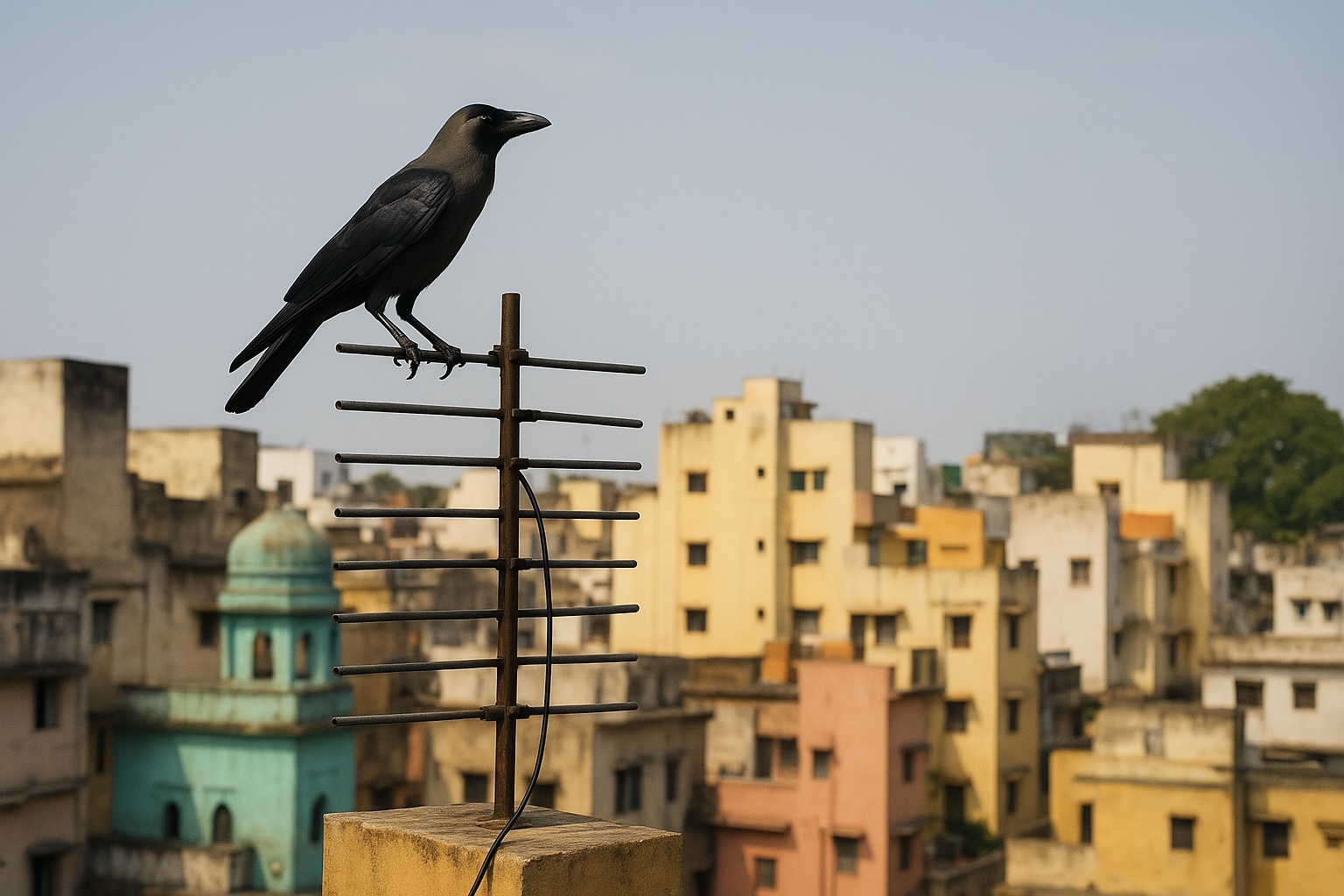
Those were the days when transmission was through an antenna that was perched on roof tops. It so happened that crows would sit on it because it provided a wonderful vantage point. From that elevated point, they could scan their surroundings for food and spot predators. Unfortunately, we were at the receiving end.
The antenna would be dislocated from its position, satellite signals would be lost, and that messed up transmission. This was a recurring problem. While one person would go to turn the antenna, viewers inside would check and see whether the picture quality improved or if anything appeared at all on the screen! In a nutshell, the crow literally decided our fate.
Moving forward by decades
How do we handle God’s plenty these days?
We have come a long way from the crow-conquered antenna era and limited TV programs. My son obviously cannot relate to my experiences, for our lives have been so different.
Here now comes a diametrically opposite scenario. We have evolved from having only a fixed schedule of programming to being overwhelmed by a plethora of content. Post dinner, we as a family sat down before the television, and after browsing across news channels, we decided to watch a movie. There were way too many streaming services, and we narrowed it down to Netflix, Prime, and Hulu. Next came the challenge of selecting a movie that all three of us would like. It was difficult for us to coalesce on one pick. Ultimately after much deliberation, we gave up on the plan and decided to do something else. This has happened several times in our house.
What comes to my mind is a local proverb that cleverly describes a scene, something that I have heard umpteen times. Gazing at a pond full of fish, a crane is overcome by greed yet is metaphorically blinded to pick anything to whet his appetite because he is confused. We too behaved similarly.
Yet another reinforcement of why our actions are often likened to those from the animal kingdom!

 rashmi writes
Interesting article! 👍🏻