
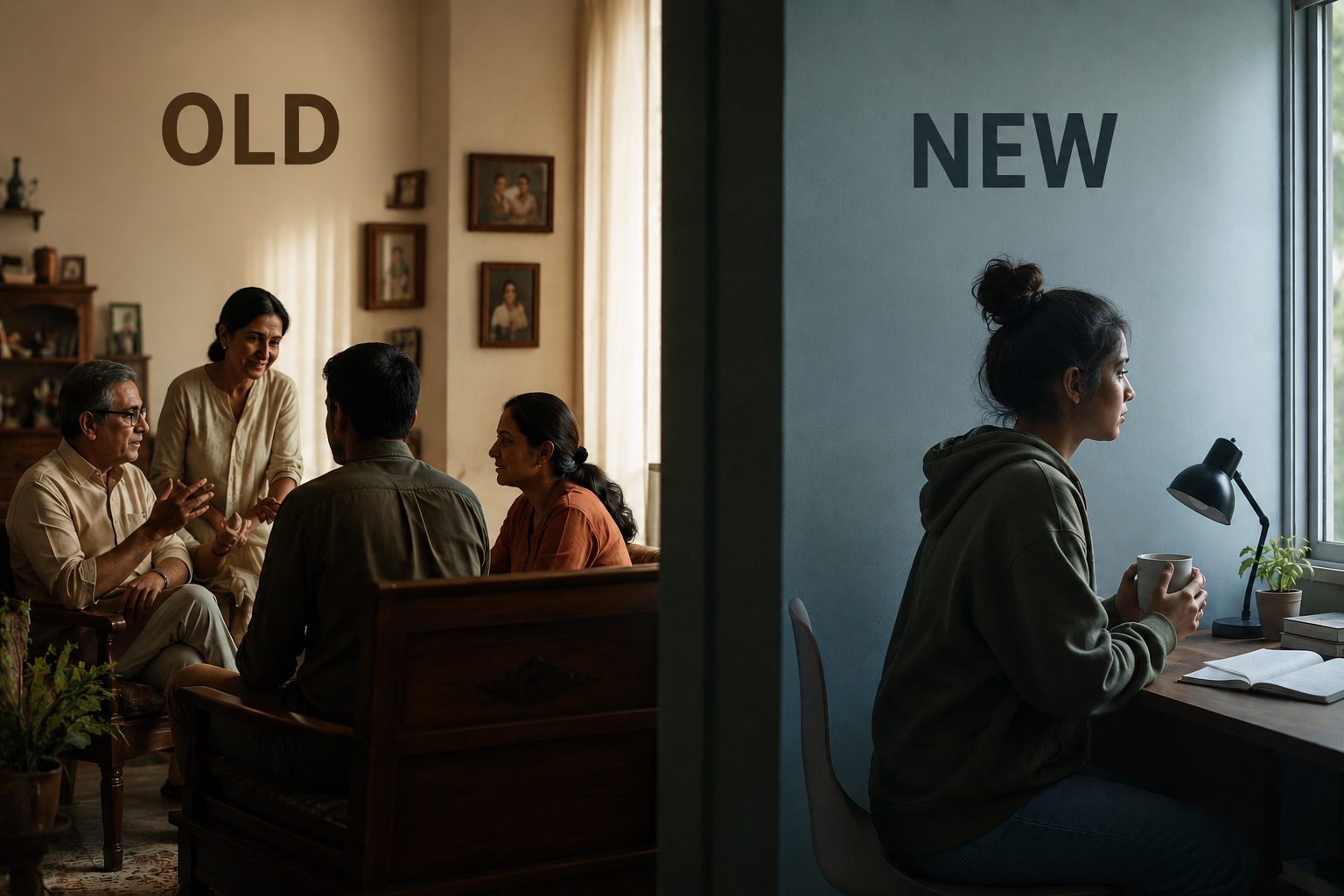
It is a stifling summer night in the 1950’s. A family of six lives in a cramped one-bedroom house. The parents sleep on a sofa-cum-bed in the living room while the children squeeze into the adjoining bedroom. In the middle of the night, one of the girls, sharing a bed with her sister, pushes her aside and yells, “I need space! You’re taking up almost the whole bed!”
Fast-forward all the way to the present day in 2026.
Inside a spacious, luxurious home in a country-club community, a young woman in her twenties slams her bedroom door. She tells her parents, “Leave me alone! I need some space!”
The common denominator in these two completely imaginary situations is ‘space’. The difference is that each girl means something entirely different when she asks for it.
For one, space is physical: a little more room to stretch out and sleep comfortably. For the other, space is something far less tangible: the freedom to be alone, to think, to breathe, and perhaps simply to be.
Unraveling the New Face of Space
Space was once understood primarily in physical terms as the distance separating one body from another. These days, it has become more than the area around the body; it has become a metaphor for the area around the mind.
If you have closely interacted with a Millennial or a member of Gen Z or if you yourself belong to one of these generations, you may have heard the phrase “Give me space” countless times. It is not necessarily a plea for physical distance, but rather a way of saying, “Respect my emotional and psychological boundaries.”
So, Is Space the New Freedom?
For younger generations, freedom is increasingly about more than independence. It is about having the right to make their own choices, live life on their own terms, and protect their individuality. Their desire for space, whether from family expectations, relationships or society’s constant demands, may well be redefining what freedom means today.
The need for space has perhaps become such a common expression because life itself has become increasingly demanding. The relentless pursuit of progress, heavier workloads, and the pressures of the modern-day rat race constantly compete for our time, attention, and emotional energy. In a world that rarely seems to slow down, the need to occasionally step back, breathe, and simply be with our thoughts has become more important than ever.
Asking for space, therefore, is not always about pushing people away. Sometimes, it is simply a request for an emotional breather, a moment to reconnect with oneself, and the chance to regain a sense of balance.
A Look at the Ripple Effect of the “Me Decade”
Ideas travel across borders and have the power to influence and inspire people to think differently. Their impact may not always be immediate, but over time, they can quietly shape attitudes, alter perspectives, and even change the way people relate to one another.
Popularised by writer Tom Wolfe, the term “Me Decade” came to define a cultural shift in American society during the 1970s. The focus increasingly turned towards individualism, personal happiness, self-discovery, self-improvement, and personal freedom. This was a marked departure from the social and political movements of the 1960s, which had largely centred on collective action and the common good.
Although the “Me Decade” was essentially an American label, the ideas associated with it gradually influenced societies in Europe and eventually other parts of the world. Such cultural shifts do not necessarily travel at the same speed everywhere, nor do they take root in identical ways. Yet the growing emphasis on the individual may well have contributed to a broader change in the way people viewed their lives.
Perhaps this is where the idea of personal space also finds an interesting connection. As individual identity and personal freedom gained greater importance, so too did the recognition that every individual may need room physically, emotionally, and psychologically to be themselves. The ideas that emerged during the “Me Decade” may not have directly created our modern understanding of personal space, but they arguably helped strengthen a cultural mindset in which the need for one’s own space came to be seen as increasingly important.
It’s Just a Newer, More Advanced Version of an Old Story
Personal boundaries and mental well-being are not entirely new concerns. It is simply that we speak about them more openly today and have developed a new vocabulary to understand and express them. The desire for freedom and the ability to think, decide, and act for oneself have, after all, always been deeply ingrained in the human spirit.
What may have changed is not the desire itself, but the way we articulate it. Terms such as “personal space”, “boundaries”, and “mental well-being” may be relatively new, but they give voice to an age-old human requirement: the need for enough freedom and space to discover who we are, to think independently, and to make our own choices.
Perhaps every generation tells the same story in its own language. Younger people too are seeking something humans have always sought. Only this time, they have mustered the courage to speak out louder and may be asking for it with a greater awareness of the self than the generations before them.


